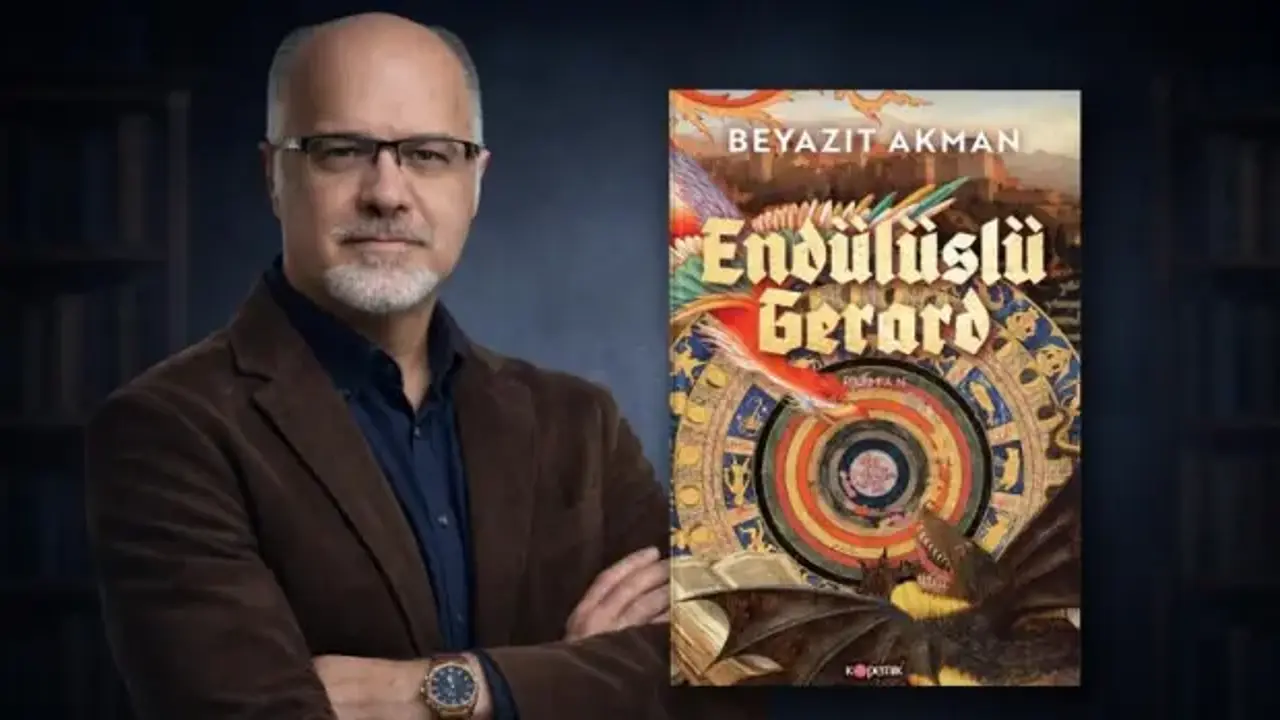
With his novel Endülüslü Gerard, Prof. Dr. Beyazıt Akman brings to light Gerard of Cremona's 40-year journey of learning, through which modern science was carried to Europe, and the decisive role Islamic scholars played in the Renaissance and today's technologies.
Published under the Kopernik Kitap imprint, Prof. Dr. Beyazıt Akman's new novel Endülüslü Gerard tells the compelling story of Gerard of Cremona, one of the key figures who laid the groundwork for the birth of the Renaissance and modern science in the Western world.
Prof. Dr. Beyazıt Akman, a faculty member at Ankara Social Sciences University, described how Gerard of Cremona, who played a key role in transferring modern science to Europe, carried the vast store of knowledge from the East to the West.
Known for his research-based historical novels and for many years of research in the United States, Akman detailed the identity and unique place in the history of science of Gerard, who changed the intellectual history of an entire continent by following a single book.
Calling Gerard of Cremona, fictionalised in his novel as Endülüslü Gerard, “one of the most important figures to bring the Renaissance to the West,” Akman said this remarkable historical figure's story began with a single book: Ptolemy's Almagest, one of the foundational works in the history of astronomy.
Akman said that in the 12th century, Gerard could not find this invaluable book anywhere in the Latin world. He therefore left his life in Cremona, in present-day Italy, behind and embarked on a dangerous journey towards al-Andalus.
“When Gerard arrives there, he discovers not only the Arabic copy of the Almagest, but also an immense treasure of knowledge stretching from Aristotle and Hippocrates to al-Khwarizmi and Avicenna. In order to translate these works, he learns Arabic with great determination and begins to work with an Andalusian scholar named Galib.”
Akman said Gerard spent 40 years translating more than 80 works in astronomy, medicine, mathematics and philosophy into Latin. “The works of Euclid, Ibn al-Haytham, al-Farabi and al-Kindi are among them. The traces of these invaluable works, which he brought to the Latin world, can be found in many fields of modern science today, from the numerals we use to astronomy,” he said.
“A CHARACTER LEFT IN THE SHADOWS OF HISTORY”
Noting that Gerard had been almost forgotten in the shadows of history for centuries despite leaving such a major mark on the history of science, Akman said:
“I encountered Gerard during my doctoral studies in the United States. While working on 1492: Gates of Heaven, published in 2012, I had the opportunity to examine him more closely. He has continued to appear at different stages of my academic research for around 15 years. Yet I saw that he was mentioned mostly in only a few lines in encyclopedia entries. Gerard leaves behind the world he knows in order to find a single book. In the end, he reaches a great treasure accumulated by humanity over centuries.”
Emphasising that he was greatly affected by Gerard's complete dedication to learning, Akman said he believed the true story deserved to reach a wider readership. He also noted that the role of Turkish-Islamic scholars such as Avicenna, al-Khwarizmi and al-Farabi in the transmission of knowledge between civilisations makes the novel even more meaningful for Turkish readers.
When assessing Latin Europe before Gerard's translations, Prof. Dr. Akman cautioned that the term “Dark Ages” should be used carefully.
Akman underlined that in the centuries when Latin Europe's intellectual production was limited, the Islamic world had a highly vibrant scientific and cultural life. He continued:
“At that time, direct access to the legacy of Ancient Greece was limited in Latin Europe, and intellectual life was largely shaped around religious institutions. It would not be right to describe all Christian thought as opposed to reason, but there were serious disputes over the boundaries between faith and reason. Figures such as Abelard, who championed questioning, faced strong reactions; some works by Aristotle and Averroes were banned in Paris in the 13th century. The acceptance of scientific thought was neither easy nor linear. Galileo's trial is the best-known example of this long tension. This is precisely where Gerard's importance emerges: by carrying into Latin the body of knowledge preserved and developed over centuries in the Islamic world, he laid a very strong foundation for Europe's scientific transformation, namely the Renaissance.”
“AL-KHWARIZMI IS BEHIND TODAY'S ARTIFICIAL INTELLIGENCE AND ALGORITHMS”
Akman said it would be the greatest injustice to view scholars such as Avicenna, al-Khwarizmi and Averroes merely as “intermediaries who preserved the Ancient Greek legacy.” He said:
“They did not merely translate the knowledge before them; they interpreted it, criticised it and carried it forward through their own original methods. Avicenna's monumental work The Canon of Medicine, by classifying diseases systematically, became one of the principal sources of European universities for centuries. Al-Khwarizmi's work was decisive in establishing algebra as an independent discipline. Hindu-Arabic numerals and zero made calculations, which were extremely difficult with Roman numerals, suddenly easier. The word ‘algebra’ comes directly from the title of his work, while ‘algorithm’ comes from the Latinised form of al-Khwarizmi's name. So al-Khwarizmi is behind today's artificial intelligence and algorithms. The name of a mathematician who lived more than a thousand years ago continues to live at the very heart of the modern technologies we use today, from artificial intelligence to banking.”
AN ADVENTURE AWAITS READERS IN THE TRAIL OF A BOOK THAT CHANGED A CIVILISATION'S FATE
Writer Beyazıt Akman said that his novel Endülüslü Gerard, which he has brought to the literary world this year, offers readers a gripping historical adventure.
Akman said that everything begins with the search for a single book unavailable in Europe, but that the protagonist soon sets out in pursuit of a greater secret. He concluded:
“As Gerard follows the trail of a greater secret hidden in the dark corridors of monasteries, burned libraries and forbidden manuscripts, some are waging war on knowledge while others risk their lives to protect it. Every text Gerard encounters becomes a new quest, and every truth he learns turns into a greater danger. As readers witness a historical adventure unfolding in Rome, Paris, Córdoba and Toledo, they will also discover with great excitement the paths by which the numerals, medicine, astronomy and philosophy we use today reached Europe. The central question of the novel will not leave us until the final page. Can a book truly change the fate of a person, even of an entire civilisation? Endülüslü Gerard is a true story whose answer is hidden in the shadows of history, in the ashes of burned manuscripts and in the pages of a book that has remained closed for centuries.”
Taking readers on a profound journey through the shadows of history, Prof. Dr. Beyazıt Akman's compelling novel Endülüslü Gerard is available under the Kopernik Kitap imprint at selected bookstores and online book sales platforms.